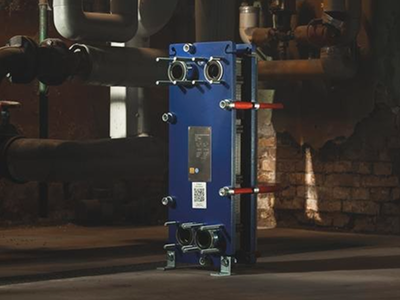
Under the right conditions, heat exchangers can operate for decades, doing their job quietly, but only if they get the attention they need. Just like a car engine, heat exchangers require regular maintenance to keep them running efficiently, energy-efficiently and safely over the long term.
But how do we know when it's time to clean? What are the signs that the heat exchanger is no longer working optimally? And why it's a job for the experts.
In some special cases, heat exchangers can operate for up to 5 years without dismantling, without any loss of efficiency. However, this also requires a suitable medium, such as soft water or glycol. In industrial environments, this is of course not always possible, as the basic function of heat exchangers is to transfer heat to different media without direct contact - be it food products (wine, beer, milk) or other substances (machine oil, paint, etc.).
In this article, we've collected the most common warning signs and show you how you can help Alfa Grade Ltd. We can assist you in the selection, maintenance and cleaning of your heat exchangers - professionally and with a guarantee.
Regular maintenance is needed to ensure that heat exchange remains continuous and heat transfer capacity does not deteriorate. But how can we decide when it is appropriate to intervene? The answer is: it depends. The composition of the medium, the temperature, the material quality of the heat exchanger and many other factors that affect its operation are not all the same.
In general, however, it is advisable to dismantle the assembled plate heat exchanger once a year and to clean the plates and gaskets one by one. At the same time, it is not advisable to overdo maintenance, as the seals will compress with each dismantling and will not be able to regain their original shape after a while. Too frequent cleaning can therefore have the opposite effect and lead to premature replacement of the seals.
On average, a seal kit can safely withstand 3-4 disassembly and reassembly operations. The lifetime of the seal is estimated to be between 3 and 5 years (although some seals have been in perfect working order for 10 years).
What are the signs that it is time for maintenance?
1. Decreasing heat transfer efficiency
One of the most common signs that it's time to clean is a drop in heat transfer efficiency. If you notice that energy consumption is increasing and the system is not working at the right efficiency, there is a good chance that deposits or dirt are blocking heat transfer.
What does this mean in practice?
- The liquid cannot absorb or release heat properly.
- Energy efficiency is deteriorating, costs are rising.
- The system may overheat or shut down.
2. Rise in pressure differential
One important operating parameter of heat exchangers is the difference between the inlet and outlet pressure. If this difference is increasing, it may indicate that deposits such as scale, sludge or other impurities have accumulated inside the system
What could cause this?
- Decreasing flow.
- Increasing energy demand for circulation.
- More serious failure if no intervention is made in time.
3. Unusual noises or vibrations
Unusual noises in the heat exchanger's operation - such as splashing, vibration or rumbling - can also indicate that there is a problem with the system. They can be caused by:
- Gas bubbles or airbags.
- Deposits that change the flow conditions.
- Worn or dirty internal components.
Don't wait until these noises lead to a more serious problem! Maintenance is now not only recommended, but essential.
4. Leaking or dripping
Every small leak can be a warning sign. Whether it's in the pipe connections or the heat exchanger body, fluid loss can be dangerous - not only from an environmental and safety point of view, but also from an economic one.
It is often detected after cleaning:
- The causes of leaks are eliminated.
- Pressure drop normalises
- Effectiveness increases
- The system can now operate without leaks again.
5. Inadequate liquid temperature
If the system cannot reach or maintain the desired temperature, this is also a warning sign. In this case, thermal resistance inside the heat exchanger reduces the system's performance.
In many cases, the problem is not the machine itself, but the lack of maintenance, and the presence of deposits. Or it could be caused by undersizing the heat exchanger.
6. Increased energy consumption
Failure to clean the heat exchanger is often at the expense of energy efficiency. Due to contaminated surfaces, reduced heat dissipation and increased operating pressure, the system uses more energy to achieve the same result. This is not only a waste of money but can also be a serious risk in the long term.
Alfa Grade Ltd - More than cleaning: a complete solution
If you are experiencing any of the above signs, do not delay! The team of experts at Alfa Grade Ltd. will help you:
- Planning regular and professional maintenance.
- Choosing the right heat exchanger.
- In professional cleaning, using chemical or physical methods.
Why should you entrust us with the maintenance of your heat exchangers?
- We have years of experience in the industry.
- We work with state-of-the-art tools and methods.
- We provide a tailor-made solution for each of our clients.
- We will prepare a maintenance plan so you can keep your equipment safe for the long term.
What happens during the cleaning process?
The cleaning process involves the following steps:
- Inspection - Visual inspection of the heat exchanger. draining.
- Dismantling - The heat exchanger is thoroughly inspected and photo documentation is taken.
- Cleaning - We use the appropriate method (e.g. chemical soaking, pressure rinsing) to remove contaminants.
- Assembly - Replacing cleaned plates and gaskets if necessary.
- Pressure test (optional) - After the assembly is completed, the heat exchanger is pressure tested to check its operation under higher pressure.
Don't wait for a failure!
Regular cleaning not only helps to prevent breakdowns, but also significantly extends the life of the heat exchanger, while reducing operating costs.
Whether you need individual advice or a complete maintenance programme, we are happy to help.
Request an appointment from our experts!
Contact us with confidence and we will help you:
- in choosing the right heat exchanger,
- the maintenance schedule,
- and carry out efficient, fast cleaning.
The heat exchanger should be one of the most reliable points of your industrial system instead of a problem!